
Getting Larimer County Court Records
The Clerk of Court for Larimer County Combined Court holds the District Court files. It holds the County Court files too. Do not go to the elected Larimer County Clerk and Recorder. That office does not certify case records. For a hearing date, courtroom, appearance type, or case number, the free Judicial Branch Docket Search is enough. CoCourts offers a broader electronic case history. Neither one substitutes for a clerk-issued copy.
When the web view falls short, use another channel. The official web form takes both document and ROA requests. You can also email, call, visit, mail, or fax the right clerk office. Old files sometimes sit off-site. Before mailing payment, confirm the destination and get an estimate. Page count, retrieval work, and redaction time can drive the final cost of a Larimer County court record.
- Find the court, case number, and document label through the docket or existing paperwork.
- Decide whether the need is a calendar entry, ROA, filed document, judgment product, transcript, or certified copy.
- Submit the official web form, email the clerk, visit the counter, or confirm mail and fax instructions by phone.
- Provide contact and mailing details, the case number, the requested document, and any certification choice.
- Review the clerk's estimate, pay the applicable fee, and verify that the delivered item is the product requested.
Larimer Court Record Request Form
Colorado's official Record/Document Request Form is the quickest web route to a Larimer County court record. Find it through the Judicial Branch form page. It wants your identity and contact information. Include a mailing address, and a case number if you have one. From there you can name the exact criminal, traffic, civil, or probate item. Pick "Register of Action/ROA" for the short chronological summary.
The form also lets you describe some other document and ask for certification or exemplification. Criminal and traffic options cover a disposition or sentence order, protection order, and ticket. Civil choices include an order for judgment, transcript of judgment, satisfaction of judgment, and protection order. The probate side covers letters, a will, trust, application, petition, closing, or claims. Fill in the fields carefully. That cuts clerk research time and lowers the odds of getting the wrong court record.
| Request field | Type | Use |
|---|---|---|
| Case Number | Text | Enter the known identifier, such as the form example 2023AA123456. |
| Record Category | Checkboxes | Select the precise criminal, traffic, civil, or probate document. |
| Register of Action | Checkbox | Requests the brief chronological case explanation. |
| Certification | Checkbox | Asks for certified or exemplified documents or information. |
| Contact and Address | Text | Supplies the response and mailing route. |
Expect a response within three business days unless extenuating circumstances exist. That clock covers the reply only. A large, archived, or redaction-heavy Larimer County court record may take longer to deliver in full. The Judicial Branch request page shows the official form fields and options.
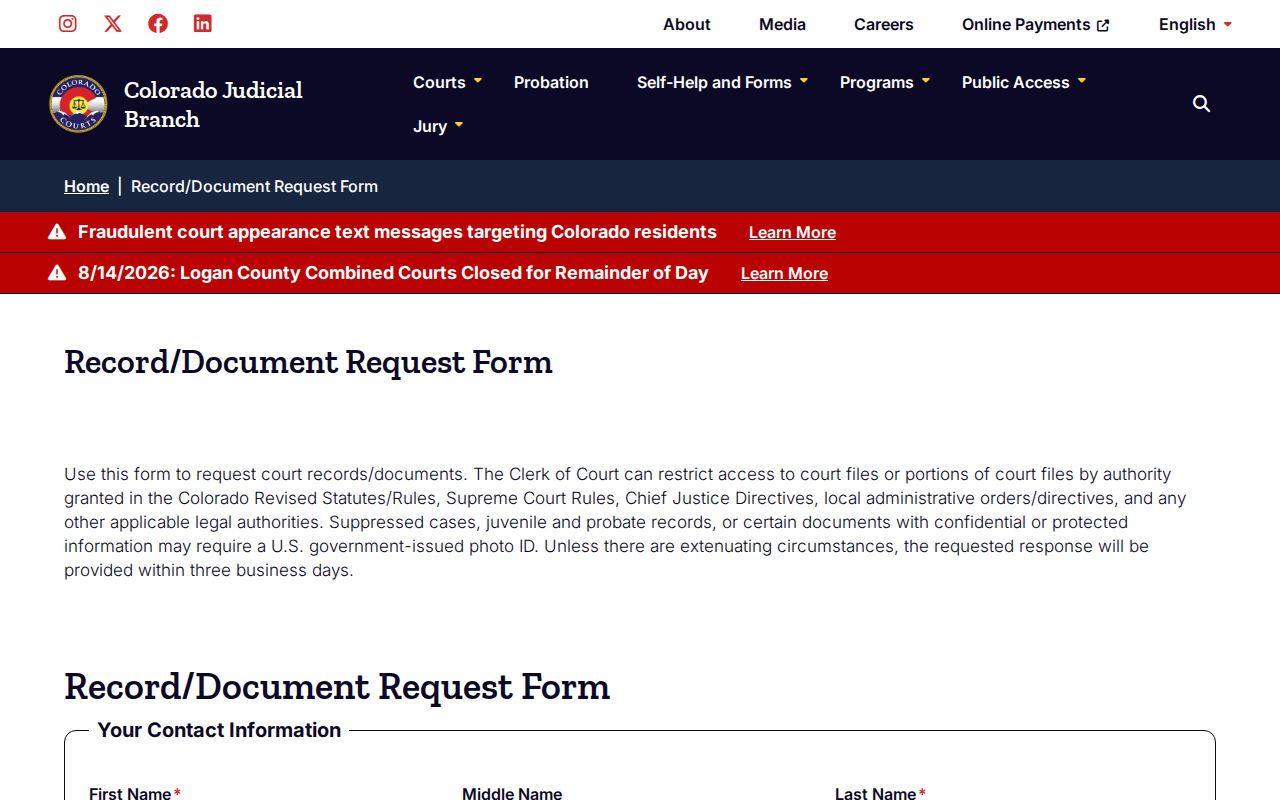
Those category and certification choices explain the smart move. Name the exact record you want. A broad request for a whole case tends to slow things down and raise the fee for a Larimer County court record.
Court Record Types
A docket and a case file are different layers of the same case. The free public docket is about settings. The ROA summarizes case events in order. Behind those events sit the filed documents: complaints, motions, minute orders, judgments, and sentences. A certified or exemplified copy adds clerk authentication when an official use demands it. Transcripts take a separate request route. They capture what was said, not just what was filed.
- Docket and calendar entries for hearings, dates, duration, courtroom, and appearance type
- Register of Action entries that summarize charges, sentences, minute orders, and case events
- Filed pleadings, motions, orders, judgments, disposition records, and sentence orders
- Domestic, probate, protection-order, small-claims, and other case-class documents where accessible
- Certified or exemplified copies authenticated by the Combined Court Clerk
A Transcript of Judgment is a clerk product used in civil judgment work. It is not a hearing transcript. For the words spoken at a proceeding, use Larimer's separate transcript process at 08transcripts@judicial.state.co.us.
Three Larimer Court Record Layers
Pick the lightest record that answers your question and save time and fees. A hearing date may need only the calendar. The full sequence calls for an ROA. The exact language of a ruling requires the filed order, and authentication is a separate service rather than a feature of any printed search screen.
| Layer | Best use | Custodian or channel |
|---|---|---|
| Docket/calendar | Confirm a current setting and location | Free Judicial Branch Docket Search |
| ROA or filed document | Read case history or exact filed text | CoCourts or Combined Court Clerk request |
| Certified copy | Obtain clerk-authenticated proof | Combined Court Clerk |
A printable docket result is still just a calendar record. Exporting or printing it does not turn it into a certified Larimer County court record.
Inside a Larimer County Court Record
A Larimer case number usually mixes a four-digit year, a class code, and a sequence. The class code tells you where to send the request. CR means district criminal, and CV means district civil. DR covers domestic relations. PR is probate. M means county misdemeanor, T county traffic, C county civil, and S small claims. What sits inside the court record then depends on the court. Case type, filing history, and access status matter too.
| Case Number | Year, case class, and sequence, used to distinguish the correct Larimer County court record. |
|---|---|
| Register of Action | Chronological summary of events, minute orders, charges, sentences, and other recorded activity. |
| Pleadings | Complaints, petitions, answers, motions, and related filed papers available under access rules. |
| Orders and Judgments | The court's filed rulings, disposition, sentence, or civil judgment product. |
| Setting Details | Date, time, duration, hearing type, location, appearance type, and courtroom. |
| Restricted Material | Sealed parts, protected identifiers, confidential exhibits, and other material withheld by law or order. |
The public calendar cannot prove what relief the court actually granted. When the findings or operative terms matter, request the signed order.
Larimer Records Beyond the ROA
A hearing transcript, an exhibit, and a sheriff report are not the same thing as the clerk's ROA. Each one lives somewhere else. A transcript preserves spoken proceedings through a court reporter or transcription channel. Exhibits can carry access limits. A sheriff report belongs to law enforcement. The Larimer County Sheriff's Office records page sends court-disposition questions back to the court.
The difference bites hardest when a calendar entry or ROA offers only a short label. A "minute order" tells you the court acted. The filed order holds the full terms. "Disposition" states an outcome, while the disposition or sentence order itself is the underlying document. Search first. Then request only the item that answers your need.
Transcript check: The $25 Transcript of Judgment is not a transcript of testimony. Use the separate Larimer transcript route for a hearing record.
Fees and Certified Copies
A plain copy just reproduces the clerk's page. Certified and exemplified copies go further, carrying the clerk's formal authentication. Colorado's official fee form charges certification per document. The page-copy charge may still apply on top of it. Parties and their attorneys get a stated cap on copy charges, non-parties get none, and research, redaction, or off-site work adds more.
| Item | Amount | Notes |
|---|---|---|
| Copy | $0.25 per page | $15 maximum for parties and their attorneys; no maximum for non-parties |
| Certified or exemplified copy | $20 per document | Page-copy charges may also apply |
| Name search | $5 | A case number can avoid ambiguity |
| Transcript of Judgment | $25 | Not a hearing transcript |
| Certificate of Satisfaction | $20 | Specific civil judgment record |
| Research or redaction | $30 per hour | Quarter-hour billing after the first hour |
| Off-site retrieval | Actual cost | Estimated by the clerk |
Larimer County Combined Court Clerk
201 LaPorte Avenue, Suite 100
Fort Collins, CO 80521
970-494-3500
Fax: 970-494-3580
08RecordRequest@judicial.state.co.us
Weekdays, 7:30 a.m. to 4:30 p.m.
Loveland County Court Clerk
810 E. 10th Street, Suite 110
Loveland, CO 80537
970-622-2100
Fax: 970-622-2149
08RecordsRequest@judicial.state.co.us
Weekdays, 8 a.m. to noon and 1 to 5 p.m.
Fort Collins Municipal Court Records
Fort Collins municipal files stay outside the state docket. The city has its own route. If the form page is unavailable, email the municipal court for a current copy. Pay only after the records clerk calculates the municipal record fee. The Fort Collins Municipal Court forms page supplies the record-request process plus future-docket and case-record searching. That official source is what appears next.
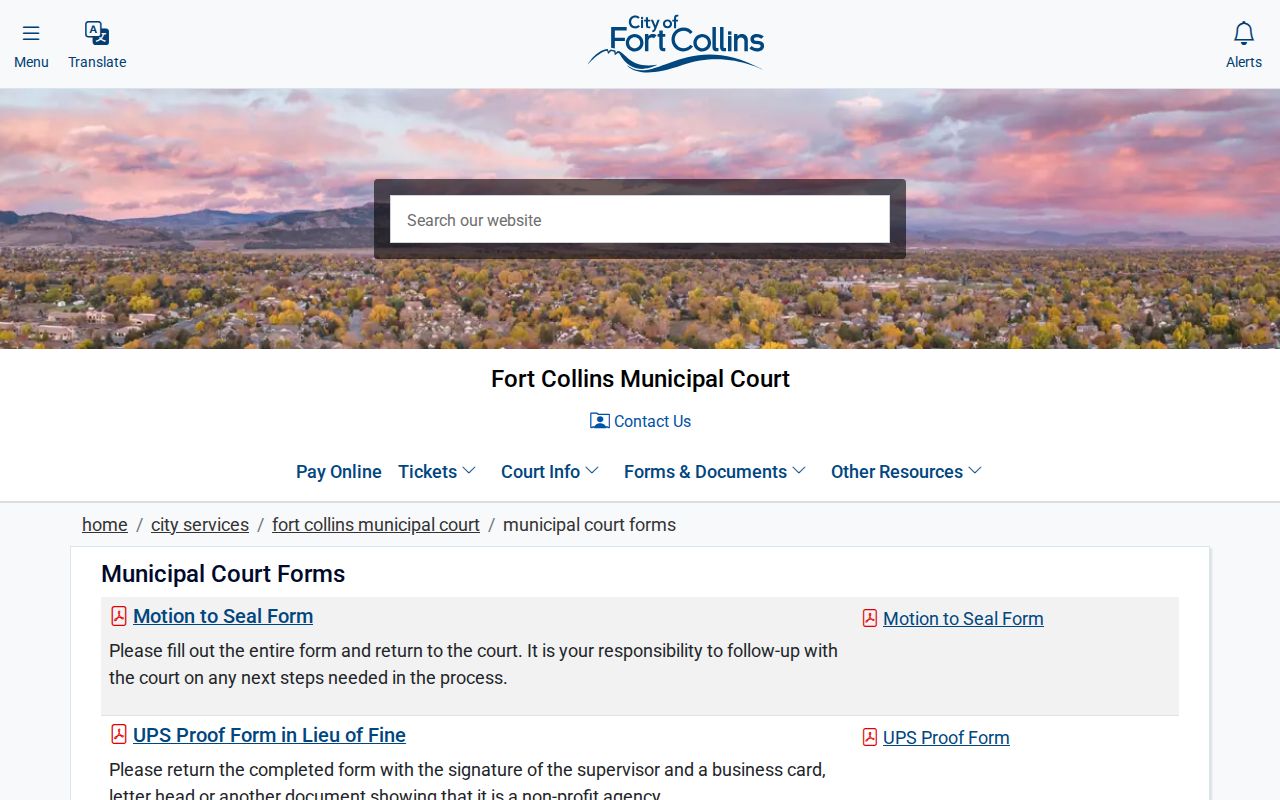
City cases run through a separate door. A Fort Collins ordinance or municipal traffic file sits with the municipal clerk, not the Larimer Combined Court Clerk. That split trips up plenty of people looking for a court docket.
Can't get the city form? Email the municipal court and ask for a current copy. Guessing at the fields wastes time. Felonies, misdemeanors, civil, domestic, probate, and state traffic files all take the Combined Court channels instead.
One more wrinkle worth knowing. In Loveland, the state County Court counter is Suite 110, and Loveland Municipal Court sits in Suite 200 of the same complex.
Sealed Records and Public Access
Not every Larimer County court record is online. Chief Justice Directive 05-01 governs access to Colorado court case records. It draws a line between remote and in-facility access. Criminal justice records follow the Colorado Criminal Justice Records Act. P.A.I.R.R. covers judicial administrative records. The Colorado Open Records Act covers many other agency records. None of them is a catchall.
Sealed records stay closed. Larimer court staff cannot verify a sealed matter without legal authority, and access may require a motion. Juvenile, suppressed, and protected probate records, along with files holding protected information, can require government photo identification and proof of access rights. A blank result can also mean a wrong court, a spelling error, an old off-site file, a municipal case, or a date filter.
Colorado access rules:
CJD 05-01 sets the Judicial Department framework for public access and exclusions.
C.R.S. §§24-72-301 through 309 govern criminal justice records and custodian decisions.
C.R.S. §19-1-301 et seq. supplies special limits for juvenile records.
For any restricted record, follow the clerk's current instructions; a routine request cannot override a sealing order.
Missing Larimer Court Record Results
A missing result proves nothing. Start with the court system itself. A municipal file may never show up in the state docket. Then test a variant spelling, a narrow but correct date range, and the full case number with its year, class, and sequence. A free calendar search can also miss the document layer that CoCourts or the clerk can reach.
Call the proper clerk about an old or off-site file. Ask about retrieval. For sealed, juvenile, suppressed, or protected records, ask what proof of identity or authority is required. Never read hidden facts into a blank screen; the real fix is a precise clerk request aimed at the office that holds the file.
One note on offices. The Combined Court clerk keeps court files. The county Clerk and Recorder handles different county records.