
Searching Larimer County Criminal Dockets
Start with the free Colorado Judicial Branch Docket Search. It opens with Larimer County already selected. Dates and settings are its strength. One filter beyond the date is required, though. A case number is the cleanest route. Party, attorney, court type, courthouse, or division filters can also narrow the Larimer County criminal docket. If you know the parts, search by year, case class, and sequence.
Remember that a result is only a calendar entry. The courtroom, appearance type, hearing label, and future date identify the current event, not a certified history. For the chronological criminal record, request the Register of Action. The Combined Court clerk keeps state District and County Court files. A city clerk handles a municipal charge.
- Identify the issuing court before entering a name or number.
- Open the Larimer-filtered docket and add a non-date filter.
- Match the year, class, sequence, location, and caption.
- Read the newest setting and confirm any reset with the clerk.
- Request the ROA or filed order when the calendar lacks the needed detail.
Larimer County Criminal Docket Classes
Larimer County case numbers carry letter codes. Those letters tell you where a criminal docket lives. CR marks a District Court felony. M typically means a County Court misdemeanor, and T points to state traffic. Municipal traffic or city ordinance cases do not follow that route. The municipal clerk keeps them, so a state court docket search may never surface them. If the letters confuse you, trust the ticket or charging paper. Trust the agency that issued it over any courthouse name you recognize.
| Case route | Typical matter | Record keeper |
|---|---|---|
| 2026-CR-#### | District Court felony case | Larimer Combined Court Clerk |
| 2026-M-#### | County Court misdemeanor | Larimer Combined Court Clerk |
| Municipal number | City-code or local traffic charge | Issuing city court clerk |
Appeals can create a second docket number. Municipal and County Court review matters may reach District Court, while a District Court merits appeal generally goes to the Colorado Court of Appeals.
Inside a Larimer County Criminal Docket
The public Larimer County criminal docket centers on settings. It can show when and where a matter is set, how long the court reserved, and whether the appearance is in person. The fuller Register of Action goes further. It adds charges, minute orders, bond events, pleas, dispositions, and sentence entries. A minute order records what the court ordered at or after a proceeding. It is not always the filed order itself.
| Case number | Four-digit year, criminal case class, and sequence. |
|---|---|
| Setting | Date, start time, scheduled duration, hearing type, and appearance type. |
| Location | Larimer courthouse, courtroom, or assigned division. |
| Charge and plea | ROA entries can identify the allegation and recorded plea posture. |
| Disposition | The outcome entry points to the separate disposition or sentence order. |
After a continuance, old settings can linger in the chronology. Confirm the current future event rather than treating the first result as the active date.
Larimer County Docket Versus Arrest Report
A sheriff's report and a Larimer County criminal docket answer very different questions. Law-enforcement records document an investigation, an arrest, or other agency action. The court record is where the criminal docket lives. It holds charges filed, settings, judicial orders, plea posture, disposition, and sentence. The Larimer County Sheriff records office says as much. It directs court-disposition questions straight to Larimer County Court. An arrest record alone cannot tell you what the court later decided.
Colorado's public-access rules for court records are published on the Colorado Judicial Branch CJD 05-01 page. That page sets out the Chief Justice Directive governing who may see what in a court file.
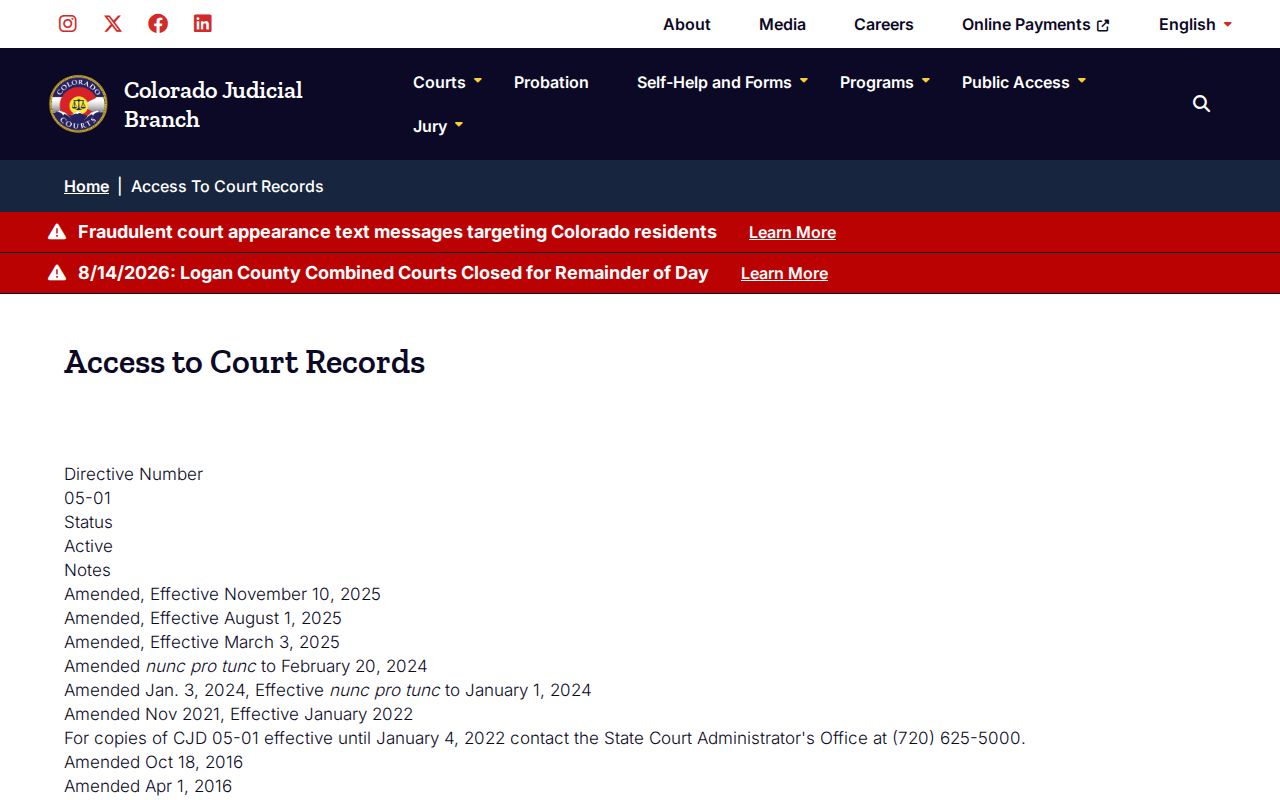
That directive is the access layer for court case records. It does not turn an agency report into a court disposition or put every criminal document online.
How a Criminal Case Moves
A Larimer County criminal docket begins once a charge or filing creates the case. That filing also assigns its class. The advisement or first hearing covers the allegation, rights, release status, and the next event. Arraignment records plea posture. From there, motions, bond orders, minute orders, pretrial settings, and continuances build the Register of Action. A plea or trial leads toward disposition. A conviction or plea may be followed by sentencing.
Larimer County docket flow: Filing › Advisement › Arraignment › Pretrial › Plea or Trial › Disposition › Sentencing
Each setting plays a distinct role. A pretrial date is not a trial date. An appearance on arrest warrant does not state the final outcome. For the filed result, select Disposition/Sentence Order on the official records request.
Larimer County also publishes special weekend bond-hearing schedules, including holiday changes. A bond hearing addresses release and custody, not the disposition of the charge. Read the hearing type before drawing any conclusion from a date. If the public criminal docket lists an advisement, arraignment, show-cause hearing, motions hearing, or sentencing, note the setting. Use that exact label. Ask the clerk to confirm the event with it. That precision helps. It lets the clerk tell a current courtroom setting apart from an older Register of Action entry.
Larimer County Competency Docket
Larimer County has something new on the criminal side. The Eighth Judicial District's FY2026 summary describes a competency docket. It is the first of its kind in Colorado. It is a specialized track, not a separate public database. A participant's public case file still travels under the ordinary Larimer County criminal case number and Register of Action. Confidential treatment or assessment material stays confidential. That holds even when the docket lists a setting. Problem-solving courts draw the same line. Under the Eighth District administrative order, staffing sessions are not open criminal court proceedings. Want into a public program proceeding or a virtual courtroom? The judicial officer decides. Search the ordinary Larimer County docket for a public setting, but do not expect internal staffing work to appear as an open hearing.
Courts That Hold Criminal Dockets
Felony dockets live at Larimer County District Court, the general-jurisdiction trial court. Larimer County Court handles misdemeanors, state traffic, and preliminary matters assigned by law. Both levels share one clerk. That clerk is the unified Larimer Combined Court. The Fort Collins Justice Center and Loveland County Court are two service locations. They are not two separate clerk systems. Municipal courts are a different world. Fort Collins, Loveland, Windsor, Johnstown, and Wellington each run their own courts. Those handle city-code and municipal traffic matters. A town can sit inside the county. Still, a city charge never slides into the Larimer County criminal docket. Check the charging paper, issuing agency, and case class first. That quick check saves you from a failed state search when a city or town clerk actually holds the record.
Larimer County Criminal Record Channels
No single channel covers every layer of a Larimer County criminal record. The Judicial Docket Search gives you a setting. The Judicial Branch lists CoCourts for broader electronic case history. Need an ROA or a certified copy? The same goes for a filed disposition or a sentence order. Use the official Record/Document Request Form. When a web result fails, old routes remain. Phone, counter, email, mail, and fax can also retrieve an older file.
Larimer Combined Court Clerk
201 LaPorte Avenue, Suite 100, Fort Collins, CO 80521
970-494-3500
Counter service: weekdays, 7:30 a.m. to 4:30 p.m.
Email: 08RecordRequest@judicial.state.co.us
Call the Loveland County Court at 970-622-2100. The counter is at 810 E. 10th Street, Suite 110, and you should confirm the destination and the total before mailing payment on an unknown page count.
Sealed Dockets and Public Access
Colorado law splits public access from remote access. A public Larimer County criminal docket setting can appear online. The filed image may still require a clerk request. Sealed cases are closed to the public. Larimer court staff cannot verify sealed case details without legal authority. Access may require a motion. Juvenile, suppressed, and protected records can also require identification and authorized status.
Key access rules:
Chief Justice Directive 05-01 sets the Judicial Department framework for access to court case records.
C.R.S. sections 24-72-301 through 309 govern Colorado criminal justice records and permit lawful restrictions.
C.R.S. section 19-1-301 and following impose special limits on juvenile records.
An empty result is not proof of no case. The miss could come from the wrong court, a variant name, an old file, a date outside the chosen range, or a lawful restriction. Blank is not the same as nothing.
Missing Larimer County Criminal Dockets
Nothing back from a Larimer County criminal docket search? Check spelling first, along with all three parts of the case number. Widen the date range too. Check the class: CR, M, T, or municipal code? Then decide what you actually want, whether a hearing, the ROA, or a signed order, because the free calendar may have no filed image even when a public case exists. For a state case, call the Combined Court clerk. For a city charge, call the municipal clerk. Old or off-site files may need a retrieval request. A public virtual courtroom link only opens the proceeding while the courtroom is open; it does not replace the docket. The District Attorney's case tracking summary is a prosecution channel, not the clerk's official Larimer County criminal court record. One last habit: recheck a future setting shortly before court, because a continuance can leave both old and new events in the case history.